Teardown ·
When the First Payment Does Not Become a Routine
My team won Banco de la República’s Bre-B challenge at Penn. Here’s why people who paid with Bre-B once weren’t coming back, and what we proposed.
Starting at the counter
This fall, my team won a challenge set by Banco de la República, Colombia’s central bank. Their team read all the proposals, then came to our class to announce the winners, and they picked ours. What stood out to them was that we thought about the shop owner and the shopper together, and about scammers. Those were two things I really cared about and kept bringing up, so hearing that from the people who actually built Bre-B felt so good.
Imagine you’re at a small corner shop in Colombia buying eggs and bread. The owner tells you the total, and before you even think about it your hand is in your pocket pulling out cash. You’ve paid with Bre-B before and it’s right there on your phone, but you still go for the notes because that’s just what you always do.
Prof. Diego Aycinena brought their case into our Interventions class at Penn. The central bank had built Bre-B, a new instant payment system, and a lot of people had tried it. My team, Caitlin Lipton, Josh Shepherd-Smith and I, had to figure out why so many people who paid with it once weren’t making it a habit.
It was a behavioral science class, but the more we worked on it, the more it felt like a product case to me. So I wanted to write it up the way I’d tear down a product.
What Bre-B is
Bre-B went live for everyone on October 6, 2025, and it’s run by the central bank. What I liked about the design is that it doesn’t ask you to download anything new. It lives inside the bank or wallet app you already use. You link a "key" to your account, which can be your phone number, your ID number or your email, and then anyone can send you money with that key from any bank in a few seconds, at no extra cost. Shops get their own merchant code.
Before Bre-B, only about 25 institutions in Colombia were part of instant payment systems. Now there are 245 banks, wallets, cooperatives and payment systems connected to it, which is a big jump.
Cash is the real competitor
When we thought about what Bre-B is actually competing with, we kept landing on cash. And honestly, cash is a really good product. You don’t need a phone or a signal, it never fails to go through, and the shop owner can see the money in their hand. Most people have paid with cash thousands of times, so they don’t really decide to use it, they just do.
This part felt familiar to me. When I was running Neel Gully, my fashion brand in India, so many of our customers still chose cash on delivery over paying online.
But I’ve also seen first hand what it looks like when it works. UPI in India is honestly a marvel. Paying with your phone became so normal there that even the smallest shops have a QR code up somewhere. So I knew cash habits could change, and the question for us was what it would take for Bre-B to get there. We didn’t think a better pitch for Bre-B would do it. We needed something that shows up right at the moment people are paying.
Walking through the counter
So we mapped out one visit to a tienda step by step, from the point of view of the person paying.
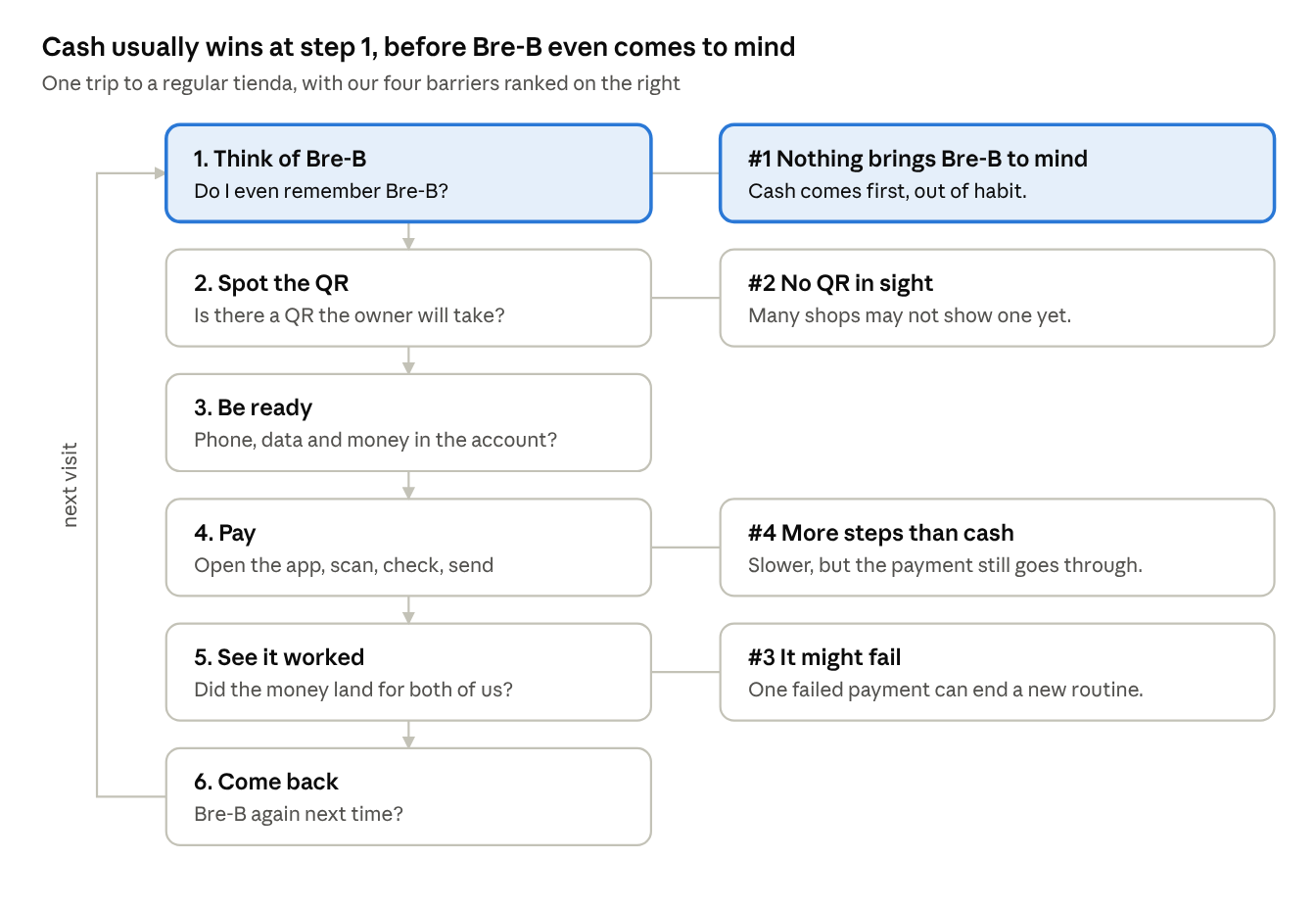
Step 6 loops back to step 1, because every visit starts the whole thing again.
What stood out to us was that cash gets through all of these steps easily every single time, while Bre-B has to get through all of them on every visit. If one step goes wrong, people just go back to cash.
We ranked four barriers:
- Nothing brings Bre-B to mind. The biggest one was right at the start. When you’re standing at the counter, there’s nothing there that reminds you Bre-B exists, so habit makes the choice before your phone even comes out.
- No QR in sight. A lot of shops might not have a QR code where you can see it.
- It might fail. Payments can fail, and one bad experience can end a new routine.
- More steps than cash. Paying with your phone just takes more steps than handing over a note, but at least the payment still goes through.
Two people at the counter
Every payment at a tienda has two people in it, and I kept thinking about the shop owner. A customer can’t pay with Bre-B if the owner doesn’t have a QR out, or if they say cash is better the moment you take out your phone.
For the owner, the questions are different:
- Is it free for me?
- Which QR goes with which account?
- Did the money actually land, or is it still pending?
- And if hardly anyone asks to pay with Bre-B, why bother putting the QR out at all?
That last one is a chicken and egg problem. Shoppers don’t look for the QR because shops don’t show it, and shops don’t show it because shoppers don’t ask.
There’s also a messier reason some owners like cash. Most micro businesses in Colombia are informal, and earlier research on card payments found some shops steer people to cash partly to avoid sales tax. We didn’t have proof that owners turn down Bre-B, so we didn’t rank it as a barrier, but it stayed in the back of our minds the whole time.
Who actually builds the fix
This was the part that made it feel the most like a product problem to me. Banco de la República runs Bre-B, but it doesn’t own the app anyone opens. Every screen people see is built by one of 245 banks and wallets. What the central bank does control is the rules, the shared look of the Bre-B section, and the standards everyone has to follow.
So every idea we had needed to work as a rule or a standard that other teams would then build. A big new feature means 245 teams building it on their own timelines and in their own way, and you can guess how that goes. A sign design, one screen or a few lines of wording is much easier to get everyone to do the same way.
Learning from what worked around the world
We spent more time researching than on anything else. Before we pitched anything, we wanted to know what other countries had tried to get people off cash, what worked, and what didn’t.
Mexico · the warning
CoDi
Its central bank launched a QR and request-to-pay system too, but banks had little reason to push it, and after six years only 11% of validated accounts had ever paid with it. That was the version of Bre-B we didn’t want: lots of sign-ups, not much use.
India · the success story
UPI
The government pays banks a fee on small shop payments and ties part of it to how reliably they run. And when demonetisation suddenly took cash away for a while, digital wallet use went up and stayed up even after the cash came back.
Mexico · it spreads locally
Corner stores and reminders
When corner stores added card terminals for families getting government transfers on debit cards, other customers in those stores started using cards too, 21% more. Even something as small as a reminder helped: reminding businesses about a lower-fee offer raised take-up by 15%.
What we pitched
When we started, a lot of our ideas were pretty big, like new features or changes to how the whole system works. I kept asking what the smallest and cheapest version could be. In my experience, it’s usually the small changes in a product that end up creating bigger change, and small things are also a lot easier to get 245 banks to actually do. We ended up with three ideas, each aimed at one of the barriers.
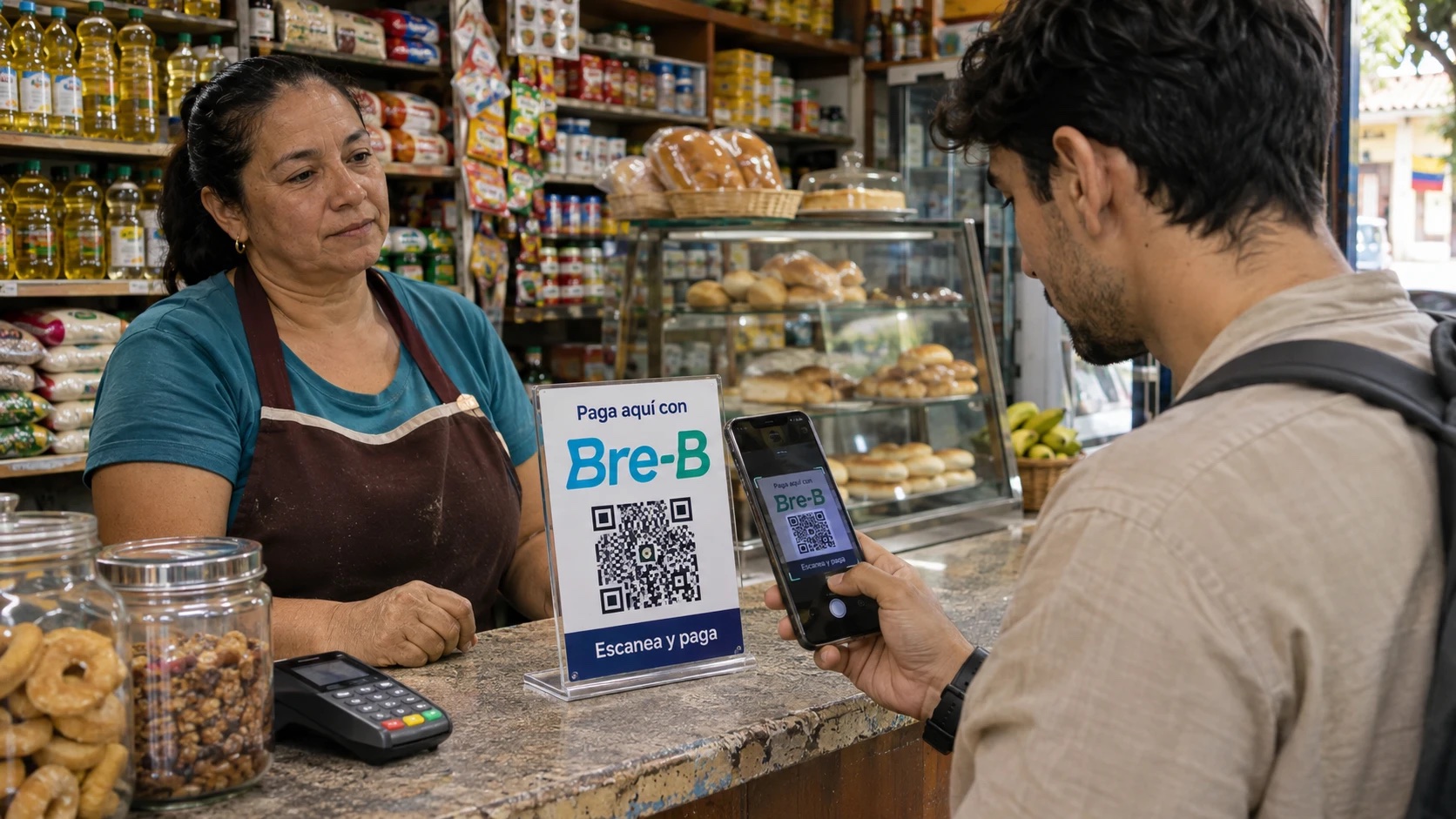
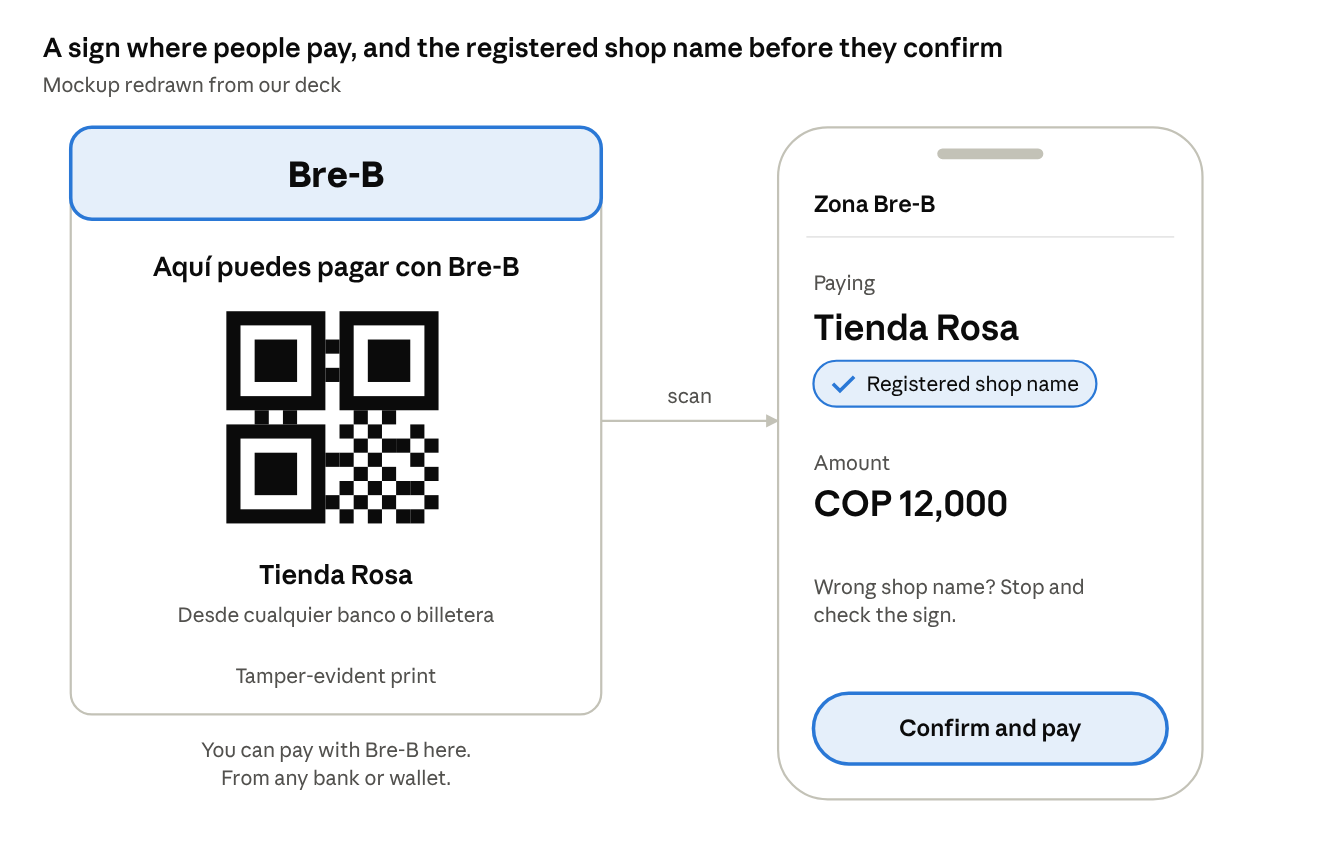
A verified Bre-B sign at the till
One bright, standard sign with the shop’s QR code, right where people pay. The habit kicks in at the counter, so the reminder needs to be there too. The bank or wallet that set up the shop’s key would print it and drop it off, starting with one busy neighborhood and then going area by area. We went local like this because in Mexico, card use spread shop by shop once stores and customers in the same area started using it together.
This one came straight from UPI. In India the printed QR code is on the cart, the counter or the stall, right where you’d otherwise reach for cash. We wanted the same for Bre-B: one sign that every tienda shows the same way.
Save the shop and plan the next visit
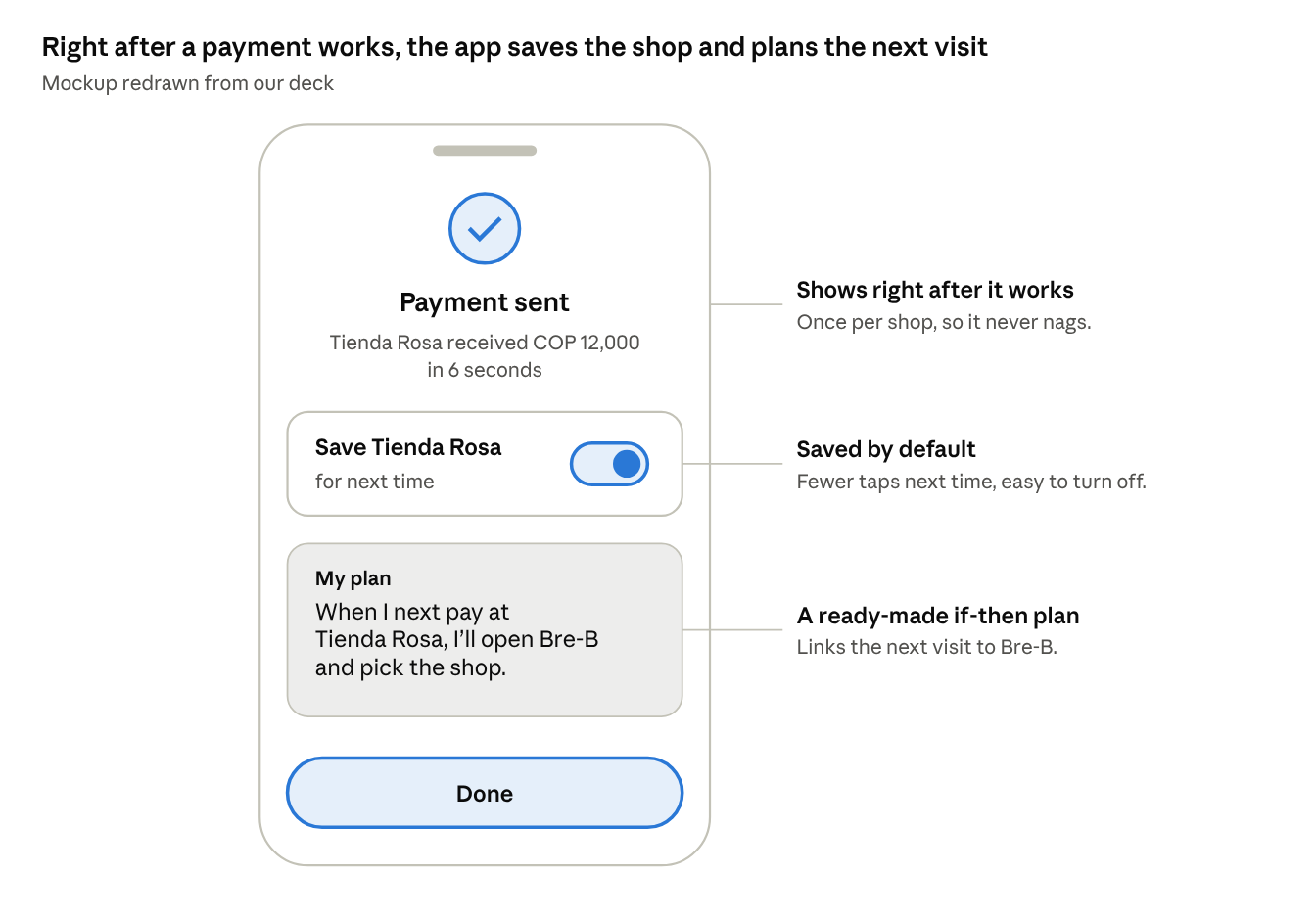
After your first Bre-B payment at a shop, the app asks if you want to save it, and it’s already switched on. Underneath there’s a small plan: "When I next pay at Tienda Rosa, I’ll open Bre-B and pick the shop." Next time it’s fewer taps. There’s research showing if-then plans like this help people break a habit in a specific place, though ours is pre-written, so the effect might be smaller. People also get tired of prompts, so this screen only shows once per shop.
Clear status messages and a minimum uptime
If a payment gets stuck, the customer and the owner both see the same plain message. "Checking" means don’t pay again yet, and "Not sent" means no money moved. A "Checking" screen could make someone pay twice, so it tells them not to. We also proposed that every bank and wallet has to stay up at least 99% of the month. India already ties part of what it pays banks for UPI to staying up more than 99.5% of the time.
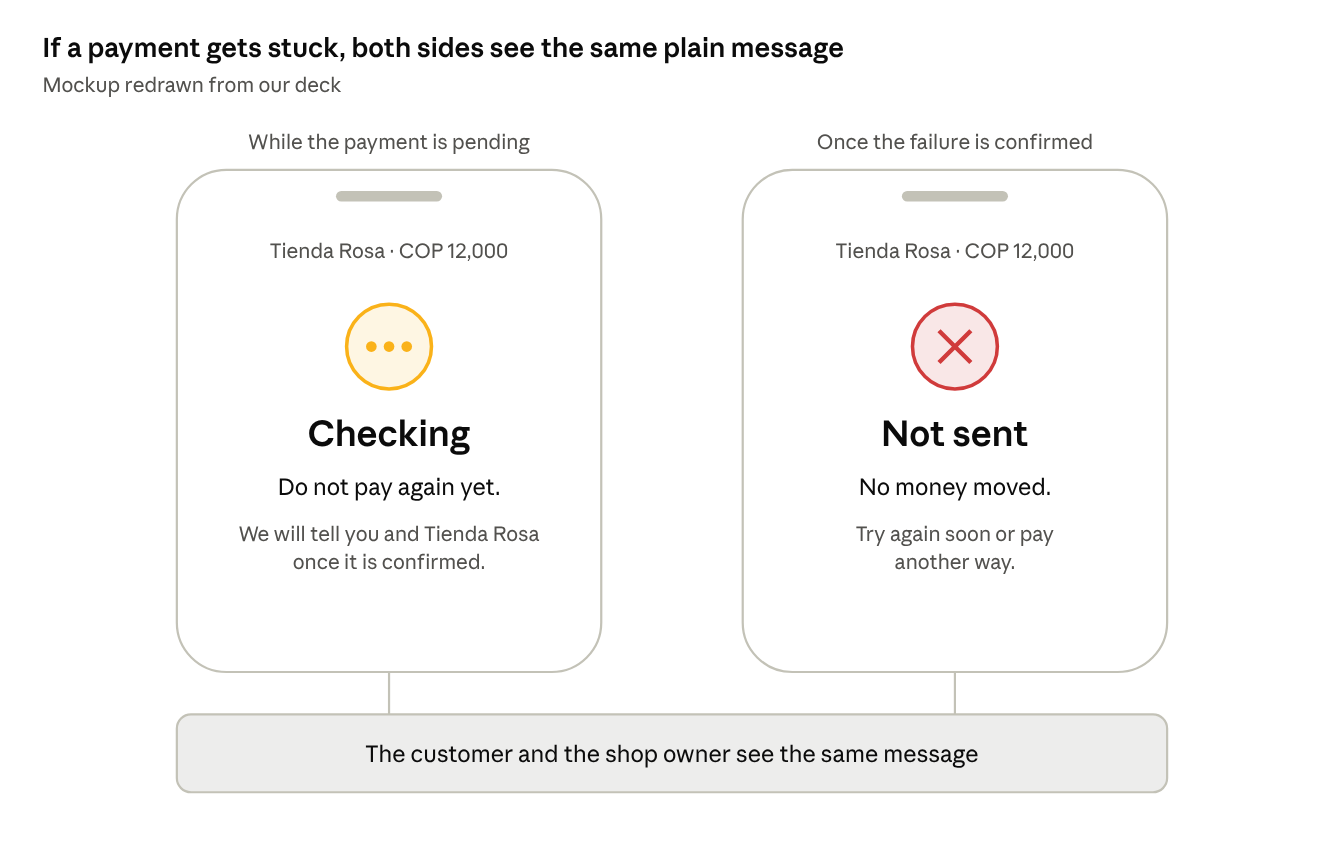
The sign and screens are our team’s designs, redrawn here.
Thinking like a scammer
Any time you put something new at a counter, someone will try to copy it. Fraud was already on people’s minds with Bre-B. When it launched, the central bank warned people to only use their bank’s official channels, since Bre-B isn’t an app of its own.
So we asked what a scammer would do with our ideas. With the sign, the easy move is to stick a fake QR on top of the real one so the money goes to someone else. Our sign is printed to be tamper-evident, so you can tell if it’s been covered. And before you confirm, the app shows the shop’s registered name. If it doesn’t say Tienda Rosa, you stop.
I think saving the shop helps here too. Once Tienda Rosa is saved, you’re paying a shop you already know, without scanning a sticker every time.
What we left out
We also dropped a few ideas along the way, and I think those calls say as much about our thinking as what we kept.
Set aside
Cashback and rewards
This was the obvious one. But it costs public money, and in studies from Pakistan and Armenia, the extra use faded once the rewards stopped.
Set aside
More education campaigns
In that same Pakistan study, giving out information alone actually lowered QR use. And knowing about something doesn’t really change a habit.
Set aside
Tax breaks or fee caps for shops
They might work, but taxes and fees aren’t decided by the central bank, so it wasn’t something our client could actually do.
Set aside
Payments between friends
We chose the corner shop because it’s the same choice in the same place every week, and that’s how habits form. Between friends there’s no fixed time or place, and the competitor is often just sending money inside the same app.
What would success look like?
My north star metric is pretty simple.
Out of the people who pay with Bre-B at a shop once, how many pay with it at the same shop again the next week, and the week after that?
We picked ten weeks at the same tienda as our window. It’s not a magic number. One well-known study found habits took anywhere from 18 to 254 days to form, and the middle was about two months.
I’d also keep an eye on a few things that tell you something is going wrong:
- people paying twice for one purchase
- reports of fake QR stickers
- how often people switch off the save toggle
- whether shop owners start complaining
If I could only ship one thing, I’d start with the sign. It goes after the biggest barrier, it’s cheap to print, and it’s easy for every bank to do the same way. It also helps with the chicken and egg problem, because customers see the QR even when they weren’t planning to ask for it.
Right now the repeat number isn’t public. The central bank shares users, keys and volume, but not who comes back. So step one would be to start measuring it, and then test the ideas in some neighborhoods and compare them with places that don’t get them. We also wrote down what would prove us wrong. For example, if people don’t come back more often at shops that show a QR, then our number one barrier probably isn’t number one.
What I’m still thinking about
I still think about the person at the counter though. Cash has worked for them their whole life and has never really let them down. For Bre-B to win, I think it has to feel easier than not thinking about it at all, and I’m honestly not sure yet how much of that you can design. Maybe a lot of it is getting the small things right and then waiting to see if people keep coming back.
Thank you to Prof. Aycinena for giving us this opportunity, and to Caitlin and Josh for being such a good team.
Sources
- Bre-B turns one, Banco de la República (Oct 2026)
- Bre-B goes live, Noticias RCN (Oct 2025)
- How Bre-B keys work, Noticias RCN
- Card use spreading shop by shop in Mexico, Higgins (2024)
- QR payments, cashback and information in Pakistan, IPA (2025)
- How long habits take to form, Lally et al. (2010)
- Why CoDi didn’t replace cash in Mexico, Argente et al. (2026)
- India’s UPI incentive tied to uptime, PIB (2025)
- Wallets after demonetisation in India, Crouzet et al. (2023)
- Reminders and firms’ take-up in Mexico, Gertler et al. (2025)
- Cashback for pensioners in Armenia, Hovanessian et al. (2026)